
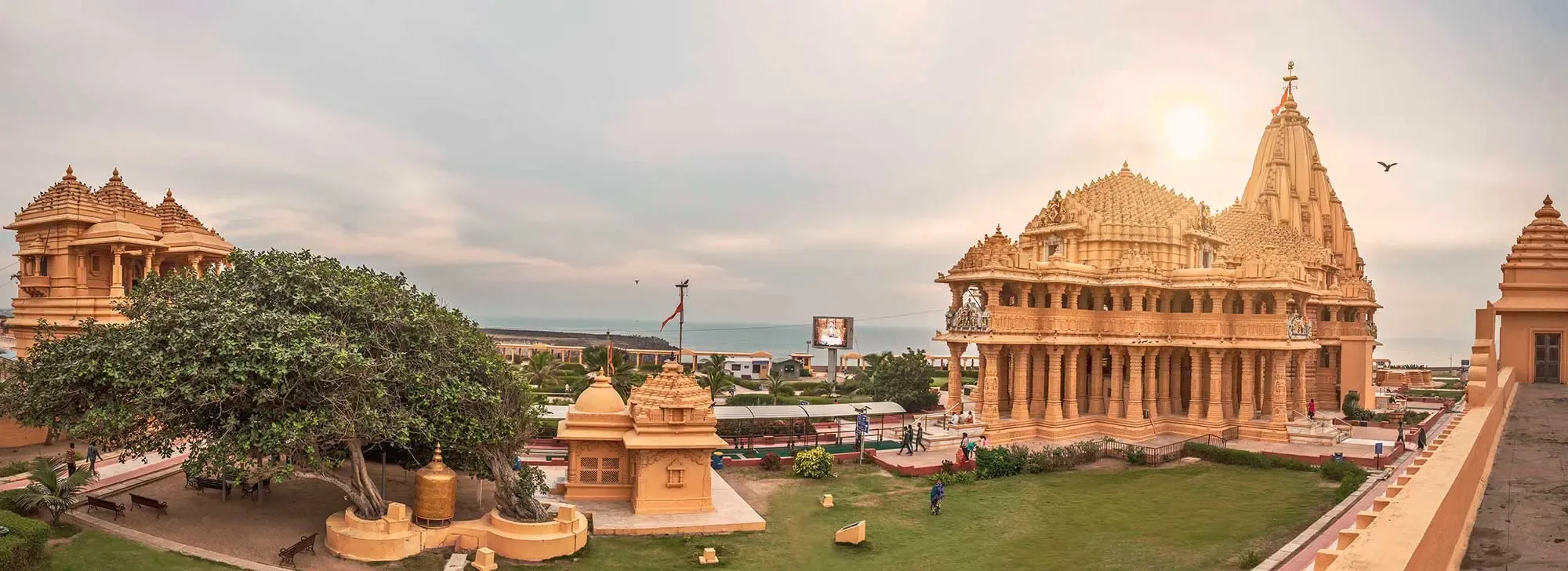
History of Somnath Temple
Somnath Temple is one of the most ancient and revered temples in India — holding a unique place in Indian history, spirituality, and cultural memory. Located on the western coast of Gujarat, it is regarded as the first of the twelve Jyotirlingas of Lord Shiva.
Beyond its religious importance, Somnath represents resilience and continuity — having witnessed centuries of historical events, invasions, destruction, and reconstruction. It is not merely a temple but a living symbol of India's unbroken spiritual tradition.
🌟 Somnath as the First Jyotirlinga
Somnath is traditionally regarded as the first among the twelve Jyotirlingas, making it a cornerstone of Shaiva pilgrimage in India.
The Jyotirlinga at Somnath symbolizes:
- Eternal presence of Shiva
- Cosmic energy
- The cycle of creation and dissolution
- The eternal and boundless presence of Lord Shiva
- Cosmic energy and the source of all creation
- The cycle of creation, sustenance, and dissolution
- The indestructibility of faith in the face of adversity
This status continues to draw devotees from across India and abroad.
🌙 Mythological Significance of Somnath
According to Hindu tradition, Somnath is closely associated with Chandra (the Moon God).
The name Somnath literally means "Lord of the Moon" — Soma being the Sanskrit name for the Moon God (Chandra), and Nath meaning Lord or Master.
It is believed that:
- Chandra worshipped Lord Shiva at this site to seek relief from a curse
- Pleased by his devotion, Lord Shiva manifested here as a Jyotirlinga
- The name Somnath literally means “Lord of the Moon”
- Chandra (Moon God) was cursed by his father-in-law Daksha, causing him to gradually lose his light and power
- Chandra came to the coast of Saurashtra and performed intense penance and worship of Lord Shiva at this site
- Pleased by Chandra's sincere devotion, Lord Shiva appeared and granted partial relief from the curse
- The waxing and waning of the moon is said to be a lasting reminder of this divine intervention
- Lord Shiva manifested at this site as a Jyotirlinga — the first of the twelve
This legend forms the spiritual foundation of Somnath’s importance in Shaivism.
📜 Historical Timeline of Somnath Temple
Somnath Temple has a long and complex history spanning more than a millennium.
Ancient Period
- References to Somnath appear in ancient texts and inscriptions
- The temple was an important religious and cultural center in early India
Medieval Period
- The temple faced repeated invasions and destruction during medieval times
- It was reconstructed multiple times by Hindu rulers and devotees
Symbol of Resilience
Each destruction was followed by rebuilding, reinforcing Somnath’s image as a symbol of unwavering faith.
🏛️ Modern Somnath Temple: Reconstruction & Architecture
The present-day Somnath Temple was reconstructed in the mid-20th century, symbolizing India’s spiritual revival and cultural continuity. The rebuilding began after independence with support from national leaders and temple trusts, and the temple was designed following traditional architectural principles.
Key highlights of the reconstruction:
- Initiated after India’s independence
- Supported by national leaders and devotees
- Built using traditional temple design
Architectural features of the present temple:
- Built in the Chalukya style of architecture
- Prominent Shikhara (tower) rising above the sanctum
- Spacious temple complex and courtyards
- Located overlooking the Arabian Sea
Today, the temple stands as a blend of devotion, heritage, and national identity.
The prominent tower rising above the sanctum — a defining feature of the Chalukya style, with intricate stone carvings rising upward.
The temple faces the Arabian Sea directly — with no land between Somnath and the South Pole, a fact documented on the famous sea-facing pillar (Baan Stambha).
Diu is tiny — you can see everything in one long day. Combine with Somnath for a perfect 3-day circuit.
Built entirely from stone in the traditional manner — no iron or steel in the original construction. The sandstone glows golden in the morning and evening light.
Photography note
🙏 Somnath — A Living Symbol of Faith and Heritage
Somnath occupies a unique place in Indian consciousness. Across centuries, it has come to represent far more than a temple — it is remembered as:
- A symbol of faith and perseverance
- A site where history and spirituality intersect
- An enduring reminder of cultural resilience
Its story continues to inspire pilgrims, historians, and visitors alike.
Today, Somnath remains:
- An active and vibrant place of worship
- A major pilgrimage destination
- A heritage site visited by millions every year
Visitors are encouraged not only to perform darshan, but also to spend time within the temple complex, understanding its historical and spiritual significance.